Ocean Freight Rate Forecast 2026: Is a Turning Point Coming?
What will the ocean freight rate be like in the second half of 2026? Will it keep rising? Those are the questions many people may ask.
The turning point has not arrived yet. Ocean freight rates will remain at peak levels through early July as carriers push new PSS and GRI fees. However, market data suggests a turning point will emerge by late July or August once the peak season demand cools down.
1. The Current State of Ocean Freight Rates
If you ship on major routes, you have likely noticed a painful trend. You receive a freight quote, and just days later, a new surcharge is added.
By mid-June 2026, the Shanghai Containerized Freight Index (SCFI) reached 2985.22. This represents a steep 9.5% jump in just one week.
This is not a short-term fluctuation on a single route. Carriers are systematically pushing up July rates across Europe, the Mediterranean, and North America using FAK, PSS, and GRI mechanisms.
2. First-Hand Carrier Surcharge Data
The Mediterranean, North America and Africa routes are seeing the steepest hikes. Shippers are struggling to lock in valid quotes before they expire.
Here are the July 1 effective surcharge announcements by some major carriers:
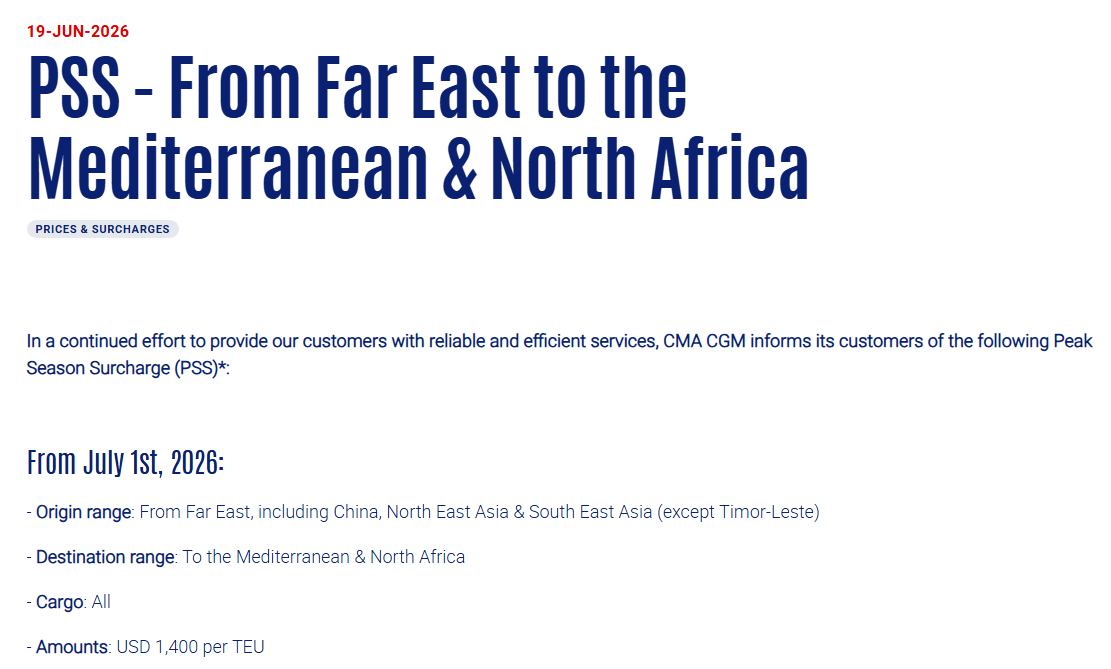
PSS Fee by CMA CGM
Effective July 1, 2026, CMA CGM will implement a Peak Season Surcharge (PSS) of USD 1,400 per TEU on all cargo shipped from the Far East—including China, Northeast Asia, and Southeast Asia (excluding Timor-Leste)—to the Mediterranean and North Africa.
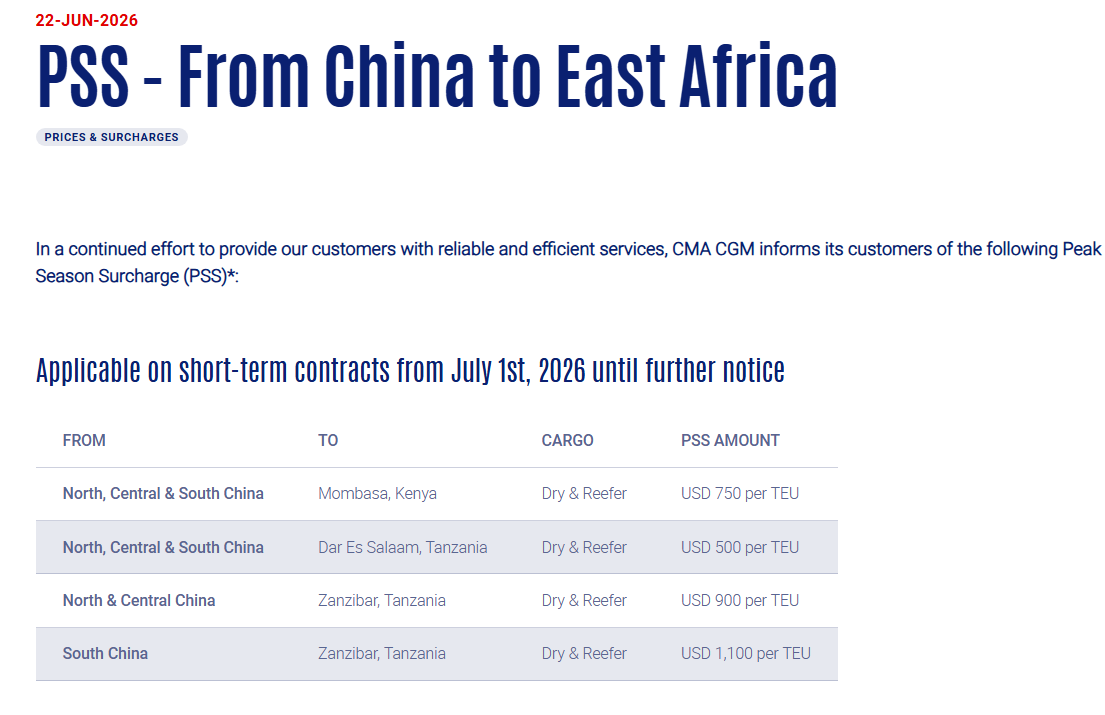
Effective July 1, 2026, CMA CGM will introduce a Peak Season Surcharge (PSS) on short-term contracts for shipments from China to East Africa. The surcharge is set at USD 750 per TEU to Mombasa (Kenya), USD 500 per TEU to Dar es Salaam (Tanzania), and USD 900–1,100 per TEU to Zanzibar (Tanzania), depending on the origin in China.
GRI by COSCO
Effective July 1, 2026, COSCO SHIPPING Lines will implement a General Rate Increase (GRI) for shipments from the Far East, the Indian Subcontinent, the Middle East, and Oceania to the United States and Canada. For U.S.-bound cargo, the GRI ranges from USD 2,400 per 20ft container to USD 3,798 per 45ft container, covering all U.S. destinations via West Coast, East Coast, Gulf Coast, and intermodal services.
For Canada, the increase ranges from USD 2,700 per 20ft container to USD 3,798 per 45ft container, applying to all Canadian destinations via Vancouver, Prince Rupert, and East Coast gateways.
PSS by Maersk
Maersk is also implementing a Peak Season Surcharge (PSS) on the Far East to India (F3W) and North America lanes. Once local fees and fuel are added, final costs are much higher.
To navigate these rapid changes, use the YQN logistics live search to find accurate FCL pricing for your specific routes.
3. Why Are Rates Spiking?
This ocean freight rate forecast is driven by three overlapping factors, rather than a single carrier's pricing strategy.
First, the peak season arrived early. Shippers rushed to move cargo ahead of e-commerce events and anticipated tariff changes. This sudden rush drained available vessel capacity.
Second, many carriers are strictly managing space. By controlling capacity and pushing synchronized FAK and GRI updates, shipping lines can easily force rates upward in a tight market.
Third, geopolitical and fuel pressures remain. Red Sea diversions continue to tie up ships, while Middle East tensions increase expected fuel and risk costs.
4. When Will the Turning Point Arrive?
The market's biggest question is whether July represents real demand or just carrier price maintenance. For early July, high rates are firmly supported by solid bookings.
However, the turning point is approaching. If the recent shipping rush exhausted future demand, cargo volumes will drop significantly in late July and August.
If cargo volumes fall, carrier rate corrections will happen quickly. We will see the true market direction by late July.
If your cargo is not urgent, waiting until late July could save you money. For critical shipments requiring secure space now, submit your details at our sea freight quote page for a reliable logistics plan.
5. How to Navigate the Market
The ocean freight rate forecast points to a highly volatile July in 2026. Keep booking windows short and monitor capacity closely. The true test of the market will come in the next two months.
If you need help securing space or navigating these rapid rate changes, chat with our expert (WhatsApp: +44 7873 164583).