
China’s Trade Surplus Hits $1 Trillion: What It Means for Global Trade
YQN Operation Team | 2025.12.18 | info@yqn.com
China’s trade surplus has reached a historic milestone. For the first 11 months of 2025, China’s goods trade surplus surpassed $1 trillion, according to data from the General Administration of Customs. This highlights the continued resilience of the country’s export sector amid global uncertainty.
Beyond the figure, this surplus reveals a deeper structural shift. Chinese media report that the main drivers of surplus growth in 2025 have moved away from traditional labor-intensive industries toward the so-called “new three” sectors: electric vehicles, lithium batteries, and photovoltaic modules.
What does this mean for global business?
China Exports Held Up Despite an Intensified U.S. Tariff War in 2025
The headline number masks a more complex reality. Chinese exporters managed to grow overall shipments even as trade friction with the United States intensified throughout 2025:
February 2025: The United States imposed an additional 10% tariff on imports from China, adding to existing duties.
April 2025: Trade tensions escalated sharply. The U.S. announced a new round of “reciprocal tariffs”, lifting average tariff rates on Chinese goods to around 84% from roughly 34%, covering a wide range of manufactured products. China responded with retaliatory tariffs on U.S. exports, deepening the trade standoff.
May 2025: Following negotiations, both sides agreed to a 90-day tariff truce. During this period, the U.S. temporarily reduced effective tariffs on Chinese imports to about 30%, while China lowered duties on U.S. goods to around 10%.
Late 2025: With tariff uncertainty still unresolved, Chinese exports to the United States fell sharply. Reuters reported that November shipments to the U.S. dropped 29% year-on-year, even as China’s total exports rebounded globally, reflecting exporters’ accelerated shift toward alternative markets.
In short: the “tariff war” of 2025 has not stopped Chinese goods from reaching the world — it has changed where and what is being shipped. Policymakers in Beijing have also responded by accelerating trade ties with other regions while urging exporters to diversify markets.

Where Did China’s Exports Go?
If China is relying less on U.S. demand, the big question is where the lost U.S. volume ended up. The answer is a pronounced pivot to emerging markets, especially Association of Southeast Asian Nations (ASEAN) and Latin America.
ASEAN: Trade between China and ASEAN reached a new record of approximately $694 billion in the first eight months of 2025, representing a 9.7% year-on-year increase. Manufactured goods is the key contributor, accounting for over 90% of total bilateral trade. Exports of machinery from China to ASEAN surged 56.1%, and automobile parts rose 22%.
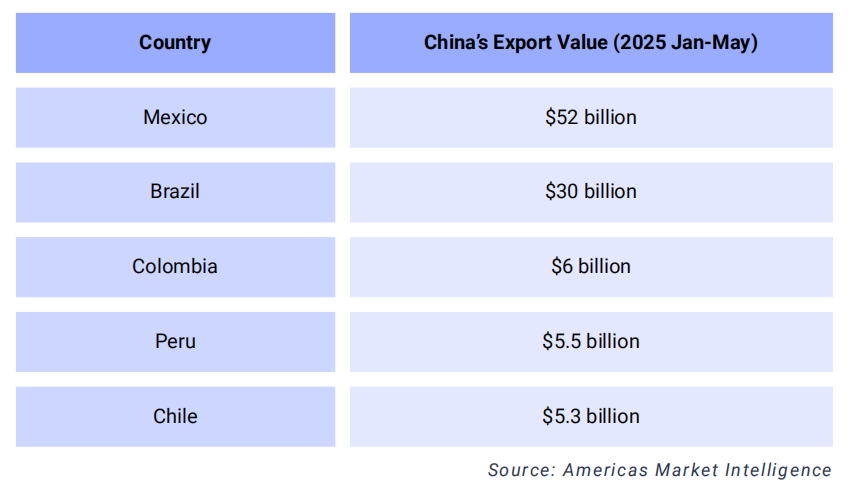
Latin America: According to AMI’s analysis of international trade data, China’s exports to key Latin American markets grew by roughly 10% overall from January to May 2025, compared with the same period in 2024. Electric vehicles (EVs) have been a standout category: Brazil imported roughly 130,000 Chinese EVs in the first five months of 2025, about ten times the volume shipped in the same period the prior year. This surge is increasingly reshaping automotive trade flows in the region.
How to Ship from China Now?
For business planning to ship from China, the recent trade reorientation reinforces a few practical points:
- Choose the right transport mode: for most finished goods and bulk electronics, China sea freight remains the cost-efficient backbone for long-distance trade. Air freight is faster but much more expensive and sensitive to capacity spikes. See how we transported trucks from China to Colombia via sea freight: Read More.
- Understand routing changes: with cargo moving to new destinations, ports and trans-shipment hubs may change; flexibility in routing (alternative ports, feeder services) reduces delays.
- Partner with a freight forwarder: a proactive china freight forwarding partner reduces lead time risk, secures space on vessels, handles customs paperwork, and optimizes landed cost.
How YQN Logistics Can Help
At YQN Logistics, we specialize in end-to-end freight forwarding solutions across major global trade lanes, including sea, air, and multimodal transport. We help simplify the process of shipping from China to key markets such as ASEAN, Latin America, Europe, and beyond, providing reliable and cost-effective logistics support at every stage.
Headquartered in Shanghai, YQN Logistics is deeply embedded in China’s logistics network, with a strong network across cities including Dalian, Tianjin, Ningbo, and Shenzhen. This extensive network enables us to deliver fast, flexible, and secure logistics solutions, tailored to the needs of yours.
Ready to ship from China? Contact us today for a competitive quote at info@yqn.com.